Can WhatsApp Chats Be Used as Evidence in Court?
Category: Select Category
Author: Adv. Rishabh Dixit
Date: 30 Jun 2026
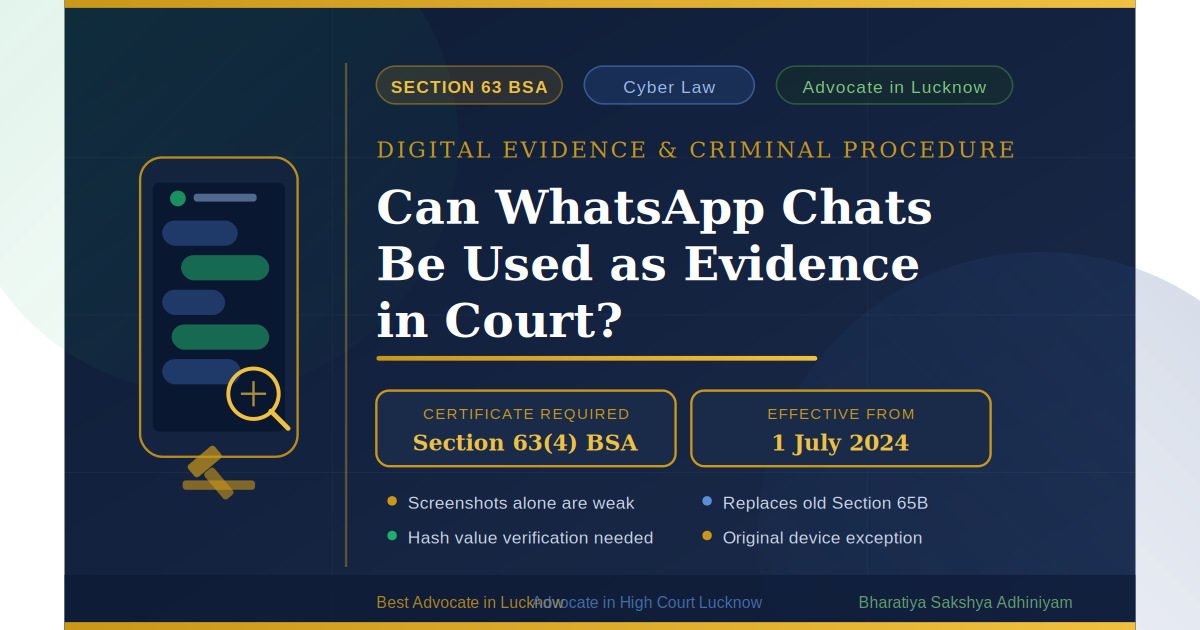
Can WhatsApp Chats Be Used as Evidence in Court?
A client walked into the office last month holding her phone like it was a weapon. "I have everything," she said. "Every message he sent me, every threat, every promise he broke. Just show this to the judge and the case is over." It had to be gently explained that it is rarely that simple. Having WhatsApp messages on your phone and getting them accepted as evidence in court are two very different things — and the gap between them has tripped up far more litigants than most people realize.
This is one of the most common questions raised with a advocate in Lucknow, whether the matter is a matrimonial dispute, a property fight, a cheque bounce case, a cyber harassment complaint, or a business disagreement. WhatsApp has become the default mode of communication for almost everyone in India — promises made, threats issued, contracts negotiated, infidelity confessed, all over chat. When relationships or deals turn sour, the natural question is: can these chats be used in court? The short answer is yes. The longer, more useful answer is what this article covers.
Yes, WhatsApp Chats Are Admissible — But Not Automatically
WhatsApp chats are admissible as evidence in India as electronic records under Section 63 of the Bharatiya Sakshya Adhiniyam, 2023, which replaced Section 65B of the Indian Evidence Act from 1 July 2024 — but only if accompanied by the Section 63(4) certificate.
That last clause — "but only if" — is where most people's cases fall apart. A WhatsApp message does not become court-worthy simply because it exists on your phone. Without that certificate, a court can refuse to read your screenshots, however genuine they are. Courts have seen perfectly authentic screenshots, with nobody on the other side even denying the messages, get rejected purely because the procedural requirement was missing.
"Genuineness is not the same as admissibility." This is the single most important principle to understand before bringing a phone full of chats into any Indian courtroom.
What Changed on 1st July 2024 — From Section 65B to Section 63 BSA
For years, every lawyer in India talked about "the 65B certificate," governed by the old Indian Evidence Act, 1872. From 1st July 2024, the Bharatiya Sakshya Adhiniyam, 2023 came into force, and the new rule now lives in Section 63. The structure shifted slightly: Section 61 gives electronic records parity with paper documents, Section 62 says their contents may be proved per Section 63, and Section 63 itself sets out the conditions and the certificate requirement.
As an advocate in Lucknow drafting evidence filings regularly, one immediate red flag is worth noting: if a case was filed after 1st July 2024 and a draft certificate still says "Section 65B," that label is technically incorrect and may be rejected. For cases filed earlier with ongoing proceedings, transitional provisions may apply — a conversation best had directly with your advocate.
The Four Conditions Section 63 BSA Actually Demands
Section 63 lays down specific technical conditions an electronic record must satisfy to be admitted without further proof of the original:
• The device was regularly used for storing or processing information during the relevant period, in the ordinary course of activity
• The type of information contained in the record was regularly fed into the device during that period
• The device was operating properly throughout, or any irregularity did not affect the record's accuracy
• The information reproduces or is accurately derived from what was actually supplied to the device
These conditions exist because digital data is fragile and editable. A screenshot can be doctored in seconds. The law is essentially asking: can you prove, in a structured and verifiable way, that this record is exactly what it claims to be?
The Section 63 Certificate — What It Actually Looks Like
Section 63(4) mandates that a certificate accompany the electronic record every time it is presented for admission. Without it, chats are treated as mere hearsay, not evidence. The certificate generally requires two parts:
Part A — from the device owner/operator, describing how the record was produced, identifying the device, and addressing the admissibility conditions above.
Part B — ideally from an independent technical expert, verifying data integrity through a cryptographic hash value, a digital fingerprint confirming the exported file matches the original.
The certificate must carry signatures from both the device-in-charge and a qualifying expert, and include hash values from a legally acceptable algorithm. This is precisely why people consult an advocate in Lucknow rather than attempting this alone — a single missing field or outdated template can result in the evidence being thrown out at the most critical stage of trial.
Common Mistakes That Get WhatsApp Evidence Rejected
• Using an old Section 65B template — lacks the Schedule format and hash requirement of the new law
• Missing device specifics — exact make, model, IMEI or MAC address should be identified
• Submitting only selected excerpts — courts expect the complete chronological record
• Omitting the other party's identifying details — courts prefer identification by phone number, not nickname
Why Screenshots Alone Are So Weak
Screenshots sit at the bottom of the reliability ladder for two reasons: first, they are trivially fabricable — anyone with a photo editor or chat generator can produce a convincing fake, and Indian courts are acutely aware of this. Second, a screenshot carries no cryptographic integrity proof — a valid record needs a hash value, and if even one character changes, the fingerprint changes completely. A screenshot has no such proof attached.
The safer route is exporting the full chat directly from WhatsApp (via the in-app Export Chat feature) rather than relying on cropped images. If screenshots are the only option, group all screenshots from a particular date or topic together rather than presenting isolated fragments — courts may object on grounds of concealment or lack of context — and record the date and time the screenshot itself was taken.
The Original Device Exception
The Supreme Court's landmark ruling in Arjun Panditrao Khotkar v. Kailash Kushanrao Gorantyal (2020) clarified that if a witness produces the original device — the actual smartphone holding the messages — no certificate is strictly necessary. This is the primary evidence route, though rarely practical for matters stretching over months or years. The Court has also reiterated that for copies of electronic records, certification remains essential, and oral testimony cannot substitute for the certificate.
How Courts Have Actually Ruled — Recent Case Law
Dell International Services India Pvt. Ltd. v. Adeel Feroze & Ors. (2024) — Delhi High Court
WhatsApp printouts and screenshots held inadmissible for lacking the Section 63 BSA certificate. The court noted that even technical compliance is not enough — genuineness, completeness, and reliability must also be demonstrated.
Chhattisgarh High Court (February 2026)
WhatsApp chats and call recordings held admissible in a matrimonial dispute under the Family Courts Act, 1984, despite objections about how they were obtained — showing family courts often take a more flexible approach than commercial courts.
Ravinder Singh @ Kaku v. State of Punjab (2022) — Supreme Court
Reaffirmed that oral evidence cannot substitute for the certificate requirement, closing off the argument that simply testifying about a message's content is sufficient.
Practical Categories Where WhatsApp Evidence Matters Most
Matrimonial and divorce disputes
Messages showing cruelty, infidelity, threats, or admissions about marriage breakdown
Cheque bounce and financial disputes
Conversations acknowledging debt or repayment terms alongside the cheque itself.
Cyber harassment and threats
Obscene, threatening, or defamatory messages forming the backbone of a criminal complaint.
Employment disputes
Messages relating to termination, workplace harassment, or unpaid dues.
Property and business disagreements
Negotiations or admissions exchanged informally before a formal contract was signed.
Step-by-Step: How to Properly Preserve and Present Evidence
Step 1 — Do not delete anything
Preserve the entire thread, not just the parts that help your case.
Step 2 — Export the full chat
Use WhatsApp's built-in export feature rather than relying solely on screenshots.
Step 3 — Note the device details
Record make, model, and IMEI of the phone — needed for the certificate.
Step 4 — Avoid repeated forwarding
Each transfer complicates chain of custody. Keep the original device safe.
Step 5 — Consult an advocate before filing
A qualified advocate in Lucknow ensures the certificate is correctly drafted.
Step 6 — Be ready with the original device
If contested, having the phone available for inspection strengthens your position.
Step 7 — Get expert hash verification for high stakes
A forensic expert's independent hash verification adds credibility hard to challenge.
Why You Need an Advocate, Not Just a Screenshot
The procedural requirements around electronic evidence in India have become genuinely sophisticated since the BSA came into force, and getting them wrong can mean your strongest evidence is simply never read by the judge. A competent advocate in Lucknow handling digital evidence will typically:
• Correctly identify whether Section 63 BSA or the older Section 65B framework applies
• Draft a complete, properly formatted Part A and Part B certificate with accurate hash values
• Advise on whether screenshots, full exports, or original-device production is the stronger route
• Anticipate likely objections from opposing counsel and prepare evidence to withstand them
• Coordinate with a forensic expert for technical certification where necessary
As an advocate in High Court Lucknow, matters have been argued where evidence that seemed conclusive at first glance was nearly excluded entirely due to a procedural gap — and matters where a properly certified WhatsApp export turned a weak case into a decisive one. The difference, almost always, came down to preparation done well before the matter reached the courtroom.
Conclusion: Real Evidence Needs the Right Paperwork
WhatsApp has quietly become one of the most consequential pieces of evidence in modern Indian litigation. The law has caught up to this reality through Section 63 of the Bharatiya Sakshya Adhiniyam, 2023 — but it has also built in real safeguards, because digital data can be faked, edited, or taken out of context far too easily.
Genuineness alone does not open the courtroom door — the certificate does. Whether dealing with a matrimonial dispute, a financial disagreement, or a business conflict, the chats on your phone could be decisive, provided they are preserved, exported, and certified correctly.
If you are in Lucknow and believe WhatsApp conversations may become relevant to your case, do not wait until trial to think about this. Speak to an experienced advocate in Lucknow early, while the evidence is fresh and the original device is still in your possession. The right preparation today can be the difference between your evidence being heard — or never being read at all.